South Africa's coastline is visited and inhabited by several whale species, but the three large baleen whales most relevant to whale watching are the Southern Right Whale, Humpback Whale and Bryde's Whale.
Southern Right and Humpback Whales are strongly seasonal migrants. They travel into or past South African coastal waters primarily during the austral winter and spring. South Africa's inshore Bryde's whales are different — they are a resident coastal population and may be present throughout the year, although their movements and visibility are influenced by prey availability, ocean conditions and location.
Whales are wild animals. Seasons describe the periods when sightings are most likely; they are not guarantees that a particular species will be seen on any individual trip.
South African whale-season summary
| Species | Status in South African waters | Broad South African season | Important qualification |
|---|---|---|---|
| Southern Right Whale | Seasonal migrant using sheltered coastal waters for mating, calving and nursing | Generally June to November, sometimes extending into December | Peak timing varies annually and by location |
| Humpback Whale | Long-distance migrant travelling along both the east and west coasts | Generally May or June to November, with regional differences | Often seen in transit rather than remaining in one bay |
| Inshore Bryde's Whale | Resident South African coastal population | Possible throughout the year | Sightings depend strongly on prey and local conditions |
South Africa is geographically extensive, and whale timing differs between the Western Cape, Garden Route, Eastern Cape and KwaZulu-Natal. The periods shown above are broad national guidelines rather than fixed arrival and departure dates.
Southern Right Whale in South Africa
Eubalaena australis
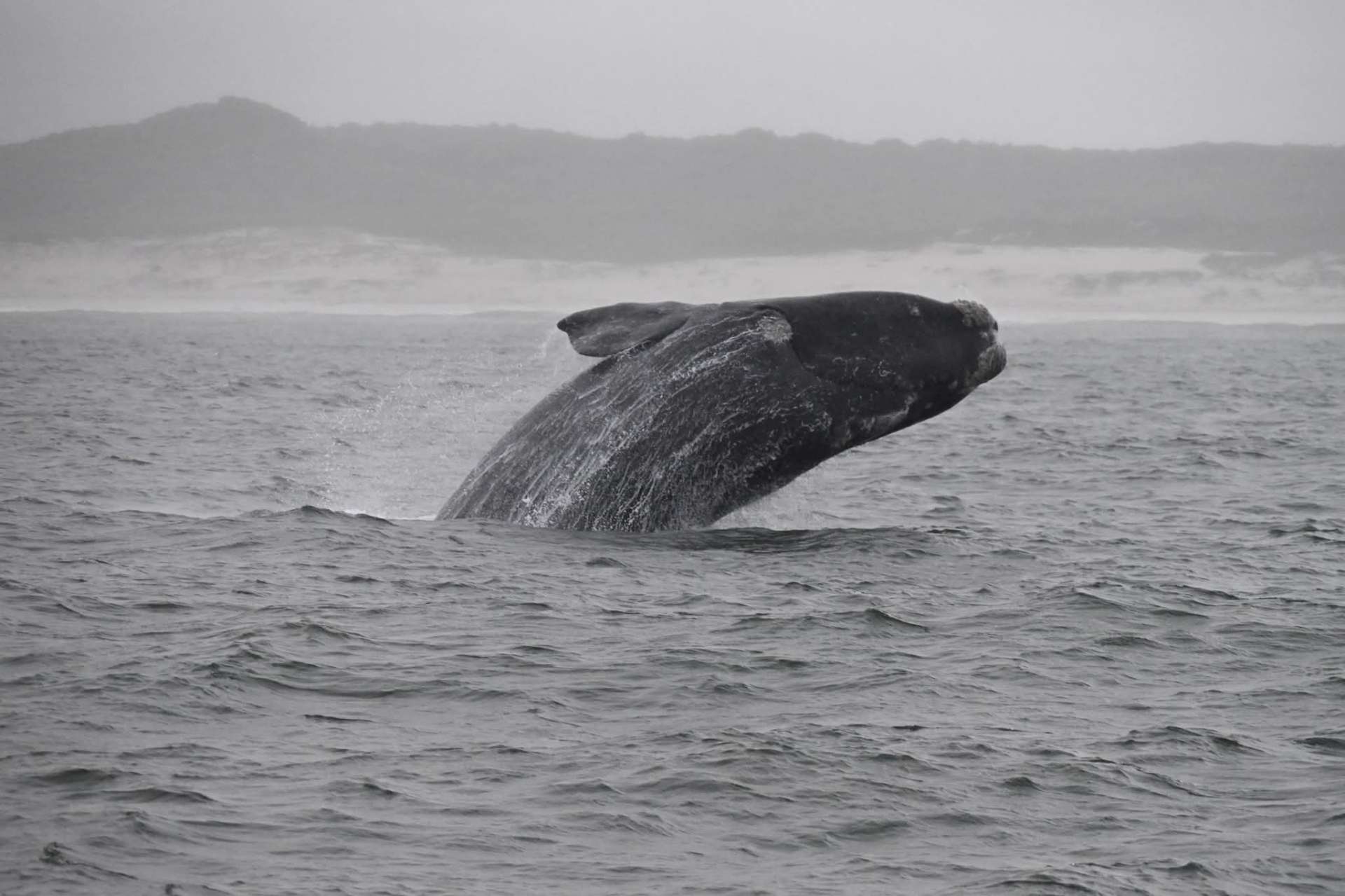
Southern Right Whales migrate from higher-latitude feeding areas in the Southern Ocean to the warmer and more sheltered waters of southern Africa during winter and spring. The South African coast serves as an important mating, calving and nursery area, and females with calves frequently use protected bays and shallow coastal waters.
The principal South African whale-watching season for this species is generally from June to November, although some animals may arrive earlier or remain into December. Along the Cape Whale Coast, Hermanus and Walker Bay are particularly well known for close land-based sightings. Research on South Africa's Southern Right Whales indicates that calving occurs broadly from late June to late October, with timing centred around the winter and early spring period. After the coastal breeding and nursery season the whales move south toward offshore and Southern Ocean feeding areas.
Identifying a Southern Right Whale
- Broad, dark body
- No dorsal fin
- Large head with roughened pale patches of skin called callosities
- Short, wide pectoral fins
- Distinctive V-shaped or bushy blow
- Frequently observed resting, rolling, tail-lifting and interacting in shallow bays
The callosity pattern on each whale's head is unique enough for researchers to identify individuals across multiple years.
Southern Right Whale season by South African region
- Hermanus, Walker Bay, Gansbaai and the Cape Whale Coast: usually present from approximately June to November, with some sightings possible into December. Commonly associated with sheltered coastal bays used by mothers and calves and often observable from both land and licensed boats. See Hermanus Whale Watching, Gansbaai Whale Watching and Kleinbaai Whale Watching & Marine Safari.
- False Bay and the Cape Peninsula: most likely during the winter and spring migration and breeding period; sightings vary substantially from year to year.
- Garden Route: Mossel Bay is commonly associated with approximately June to October; Knysna and Plettenberg Bay record varying seasonal windows across winter to spring — confirm local availability with the operator.
- Eastern Cape: seasonal animals may occur during migration; local abundance and timing vary.
- KwaZulu-Natal: Southern Right Whales may occur, but Humpback Whales are generally the more characteristic large migratory whale along this coastline.
Behaviour and reproduction
Southern Right Whales come close to South Africa mainly to mate, give birth and nurse calves. Mothers and calves often occupy shallow coastal waters, and adults rely heavily on stored energy reserves while in breeding and nursery areas. Their main feeding areas are farther south, where they feed primarily by filtering zooplankton such as copepods and krill through baleen.
Humpback Whale in South Africa
Megaptera novaeangliae
Humpback Whales undertake one of the longest migrations of any mammal. Southern Hemisphere Humpbacks generally feed in productive Antarctic and sub-Antarctic waters during the austral summer and migrate toward warmer tropical and subtropical waters during winter to mate and give birth. South Africa lies along two major migration corridors: an east-coast route used by whales moving through the Mozambique Channel toward breeding areas off Mozambique and farther north, and a west-coast route used by whales moving along the Atlantic side of southern Africa toward breeding areas off western Africa. This means Humpbacks are often seen travelling past South Africa rather than remaining for an entire season in one sheltered bay.
Broad Humpback season in South Africa
Humpback Whales are generally seen along the South African coast from approximately May or June through November. Exact timing differs by coastline, direction of migration and year. The northward migration is generally most evident during late autumn and winter, and the southward return migration occurs during late winter, spring and sometimes early summer. Mothers with calves may be particularly noticeable during the southward migration. Migration timing overlaps, animals do not all travel simultaneously, and occasional sightings outside the main period are possible.
Humpback Whale season by region
- Western Cape and Cape Whale Coast: commonly recorded during the winter migration period. The International Whaling Commission's South Africa profile lists June to August as an important viewing period around Simon's Town, Hermanus, Gansbaai and Kleinbaai; sightings may continue later but are variable.
- Garden Route: Humpbacks can occur along the Garden Route for a broader portion of the year than Southern Right Whales, extending through the migration season around Knysna and Plettenberg Bay. Sightings are not equally reliable in every month.
- Eastern Cape and Algoa Bay: Humpbacks migrate past the Eastern Cape. The IWC profile identifies approximately June to November for Algoa Bay / Gqeberha, with animals often seen travelling, breaching or accompanied by calves.
- KwaZulu-Natal and St Lucia: one of South Africa's important Humpback migration corridors. The broad boat-based viewing period is generally around June to September in the St Lucia region; southward migration may continue later along parts of the coast.
West Coast operators also target Humpback feeding aggregations off the Atlantic seaboard — see our Yzerfontein Humpback Whale Expedition.
Identifying a Humpback Whale
- Very long pectoral fins
- Knobbly tubercles on the head
- Small dorsal fin on a raised hump
- Broad tail flukes with individually distinctive markings
- Dark body with variable white markings
- Bushy blow
- Frequent breaching, tail-slapping and pectoral-fin slapping
The name "Humpback" refers to the pronounced arch of the back as the whale prepares to dive.
Feeding, migration and song
Southern Hemisphere Humpbacks feed mainly in high-latitude southern waters and migrate north into warmer waters for mating and calving. They generally rely substantially on stored energy during migration and breeding, although opportunistic feeding along the route can occur; prey may include krill and schooling fish depending on location. Male Humpback Whales produce complex, structured songs associated principally with breeding behaviour; the song pattern changes gradually over time.
South Africa's Resident Inshore Bryde's Whale
Balaenoptera edeni (Bryde's whale taxonomy remains complex)
South Africa supports a small, genetically distinct inshore population of Bryde's whales. This coastal population has a restricted distribution associated mainly with South Africa's continental shelf and the Agulhas Bank, and is resident in South African waters throughout the year. Ecologically it differs from the wider-ranging offshore Bryde's whale form and should not be combined with it. It is sometimes informally described as South Africa's endemic inshore form, but the safest scientifically accurate description is South Africa's resident, genetically distinct inshore Bryde's whale population — the Bryde's whale species as a whole is not endemic to South Africa.
Unlike Southern Right and Humpback Whales, the inshore Bryde's whales do not undertake a predictable annual migration away from South Africa. They are considered resident and may be encountered at any time of year, though sightings are not guaranteed.
Distribution in South Africa
- Restricted coastal distribution along South Africa's southern and southwestern coastline
- Strongly associated with the Agulhas Bank and productive shelf waters
- Sightings occur in areas including False Bay, the Cape south coast, the Garden Route and Algoa Bay
- Location may change seasonally in response to prey, upwelling, water temperature and other oceanographic conditions
- A separate offshore Bryde's whale form occurs farther from shore with different distribution and movement patterns
Bryde's Whale viewing patterns
South Africa's inshore Bryde's whales are resident throughout the year. There is therefore no single Bryde's whale "season" equivalent to the Southern Right Whale season. However, the chance of seeing them changes by location and month because they follow mobile prey such as anchovy, sardine and other schooling fish.
- Hermanus, Gansbaai and Kleinbaai: may be encountered throughout the year. The IWC profile identifies July to November as a strong viewing period for some Western Cape boat-based locations — a local viewing pattern rather than a migration season.
- Knysna and the Garden Route: Bryde's whales may be seen over a broad period; the IWC profile lists local vessel-based viewing opportunities from approximately July to April. Presence outside these months is possible.
- Algoa Bay and Port Elizabeth / Gqeberha: Bryde's whales are an important component of the local marine ecosystem; sightings are closely connected to the availability of schooling fish. The IWC country profile identifies September to November as a peak viewing period in the Eastern Cape.
Identifying a Bryde's Whale
- Sleek, streamlined rorqual body
- Tall, curved dorsal fin positioned far back on the body
- Pointed head
- Three prominent longitudinal ridges on top of the head — one central and two lateral (a key distinguishing feature)
- Narrow, upright or slightly bushy blow
- Surfaces irregularly and may change direction quickly while feeding
Identification at sea can be difficult, especially when only the back and dorsal fin are visible; Bryde's whales can be confused with Sei, Fin and Minke whales.
Feeding
Bryde's whales are baleen whales. South Africa's inshore population feeds heavily on schooling fish including anchovy, sardine and maasbanker (horse mackerel). They may lunge through tightly packed fish schools and are often associated with feeding activity involving dolphins, Cape gannets, seals, penguins and predatory fish. Their presence can be highly responsive to changing fish distribution — they feed on more than just sardines and do not occur only during the Sardine Run.
Conservation status
South Africa's inshore Bryde's whale population is small, genetically distinct and nationally assessed as Vulnerable. Published South African research commonly describes the population as numbering fewer than 1,000 mature animals, with some historical estimates around 600 individuals; because estimates and assessment methods change, no single figure should be treated as a precise current population count. Documented pressures may include entanglement in fishing gear, ship strikes, changes in prey availability, overfishing of important prey species, underwater noise, coastal and offshore development, and climate-driven ecosystem change.
How to tell the three whales apart
| Feature | Southern Right Whale | Humpback Whale | Inshore Bryde's Whale |
|---|---|---|---|
| Dorsal fin | None | Small fin on a hump | Tall, curved fin |
| Head | Large head with callosities | Knobbly head with tubercles | Pointed head with three ridges |
| Pectoral fins | Short and broad | Exceptionally long | Relatively short and slender |
| Typical SA status | Seasonal coastal visitor | Seasonal migrant | Resident |
| Common behaviour | Resting, rolling, tail lifting | Breaching and fin slapping | Fast, irregular feeding movements |
| Broad viewing period | June–November | May/June–November | Possible year-round |
Behaviour varies between individuals and no single surface action proves the species. Identification should use a combination of head shape, dorsal fin, pectoral fins, body profile and behaviour.
Regional South African whale calendar
Hermanus and Walker Bay
- Southern Right Whale: June–November; possible into December.
- Humpback Whale: strongest during winter migration (around June–August), with variable later sightings.
- Bryde's Whale: possible year-round; local viewing probability varies.
Gansbaai and Kleinbaai
- Southern Right Whale: June–November.
- Humpback Whale: mainly winter migration period, with variable spring sightings.
- Bryde's Whale: possible year-round; locally stronger periods may occur.
Mossel Bay
- Southern Right Whale: approximately June–October.
- Humpback Whale: winter through spring migration period.
- Bryde's Whale: possible year-round but unpredictable.
Knysna and Plettenberg Bay
- Southern Right Whale: approximately July–October in many local viewing guides.
- Humpback Whale: broad migration period from winter through spring, with local variation.
- Bryde's Whale: broad potential viewing window; IWC profile lists July–April for Knysna vessel-based observations.
Algoa Bay and Gqeberha / Port Elizabeth
- Southern Right Whale: seasonal and variable.
- Humpback Whale: approximately June–November.
- Bryde's Whale: resident, with an identified local peak around September–November.
St Lucia and KwaZulu-Natal
- Humpback Whale: the principal large-whale attraction, generally around June–September for local boat-based viewing.
- Southern Right Whale: possible but not the main species promoted.
- Bryde's Whale: possible in wider regional waters; not advertised as a reliable coastal sighting.
These periods are based on broad South African and regional observation patterns. Weather, prey distribution, ocean conditions and natural annual variation affect sightings. Always confirm the operating season and recent sightings with the relevant permitted boat operator.
Plan a South African whale-watching trip
Choose a destination and season from our regional guides: Hermanus, Gansbaai, Kleinbaai Marine Safari, Mossel Bay, Knysna, Plettenberg Bay, Port Elizabeth / Gqeberha, or explore the South Africa Whale Watching Map. See Best Time for Whale Watching in Hermanus, Whale Watching Season in South Africa and Whale Watching Prices to plan further.
Sources: International Whaling Commission (Whale Watching Handbook and South Africa country profile), South African Department of Forestry, Fisheries and the Environment, South African National Biodiversity Institute assessments, Endangered Wildlife Trust South African mammal assessments, University of Pretoria Mammal Research Institute Whale Unit, and peer-reviewed South African marine-mammal research. Local operational seasons and location-specific sightings are drawn from permitted South African whale-watching operators.